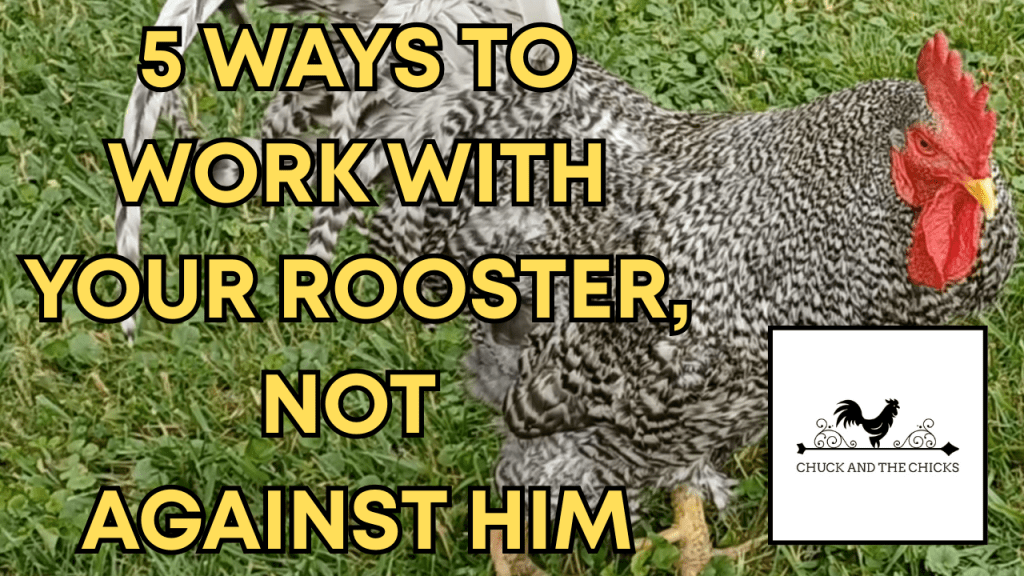
5 Ways To Work With Your Rooster, Not Against Him
Roosters are a highly misunderstood presence in the backyard flock. Roosters are the male counterpart to a hen. Roosters don’t lay eggs. Their two primary roles within the flock are 1) to protect their flock from predators and 2) to service hens to provide for the next generation of chickens. Much like the pit bull dog breed, a rooster’s high energy and natural behaviors if they are not given the proper circumstances, they need to succeed can become aggressive, violent, and destructive. There are some individual roosters that because of poor breeding, prior abuse, disease, their individual temperament, or other issues will not respond to training and ideal circumstances regardless of your patience and efforts. However, the majority of roosters when given what they need to succeed, and with some intentional, consistent, kindly motivated training, can be a wonderful and peaceful backyard flock member. To successfully interact with your rooster, it is important to work with his natural instincts, not against them, to ensure you don’t accidentally become the target of his protective efforts. Roosters are devoted protectors and would readily lay down their life to protect their flock. Roosters also contribute to overall flock harmony by meditating pecking order squabbles.
The idea that roosters only crow at dawn is a myth. Rooster crow throughout the day and for a variety of reasons. My roosters typically crow at dawn, at lunchtime, and at dusk. Roosters crow for a variety of reasons including inter-flock communication, spotting potential threats, declaring territory, and others. If your rooster is crowing in the middle of the night when the flock should be sleeping, it is an indicator of an issue. Issues that cause this could include things like mid-evening disruptions to the flock sleeping like loud noises or bright lights, inadequate space, or an undetected predator presence. Mid-evening crowing should be examined as a potential predator threat or environmental issue, not as a behavioral problem.
Your rooster has naturally fluctuating hormones that change seasonally. During the spring, you can expect even normally docile roosters to demonstrate sparring and other behaviors appropriate to the season. A rooster’s virility and aggressiveness will both substantially wane once he is over 3 years of age. In my lived experience being a hand-tame, gentle rooster does not negatively impact virility.
Choosing a friendly breed of chicken for your rooster is something you can do to set yourself and your rooster up for success. Choose breeds that are known to be docile like the Barred rock, the Australorp, the Orpington, the Polish, and others. Breeds like game breeds and others have been bred to more aggressive and wouldn’t be a good fit for backyard setting.
There a few circumstances where I would not recommend someone have a rooster in their flock.
Firstly, if you don’t want one. Owning a rooster is a commitment to train and interact with an intact male livestock animal. Even well-behaved gentleman roosters require some work and training. You don’t have to have a rooster for your hens to lay eggs. Without a rooster in the flock, a hen will assume the social role of the flock protector. You need a rooster if you want fertile eggs that can be hatched into chicks.
If you legally can’t have one in your area. While some areas may allow backyard chickens many still have restrictions pertaining to owning roosters. Their presence is virtually impossible to conceal.
If you have small children or are often visited by small children. The loud noise and chaotic movements of small children and especially unfamiliar children can inspire a rooster’s protective instincts. It is very likely for a rooster to perceive small children darting around near his flock as a threat and he may flog or spur them. Roosters can absolutely be trained to interact positively with children but it takes effort to both train the rooster and demonstrate to the children how to safely interact with your animals. If you have a rooster, I would recommend either keeping your rooster in confinement with his flock while small children visited or simply avoid having one altogether.
Here are 5 tips to work with your rooster to bring out the best outcomes possible.
Ensure your flock has adequate space. Cramped, inadequate space poses many behavioral and health dangers to your flock but this is especially true for roosters. Roosters by nature are high energy and vigilant. Inadequate space can inspire aggression and many other undesirable behaviors. Provide your flock and your rooster with as much space to explore during the day as you feasibly can. If your flock will be living partially or in fulltime confinement be sure to utilize things like enrichment items, toys, treats, roosting and perching space, and other ideas to keep your flock and your rooster engaged and healthy.
Provide your rooster with adequate mates. Your rooster can reliably service up to ten hens, meaning the majority of eggs produced by those ten hens would be fertile and have the potential to hatched into chicks. Typically, it is recommended to have at least 6-7 hens per rooster. Without adequate mates, a rooster can easily overbreed and unintentionally harm his hens if he doesn’t have enough options. It is important to choose a rooster that is also a good size match for your flock. While a rooster being the male counterpart to a hen will naturally be larger in size, if the size difference is too extreme this can cause unintentional injury like excessive feather loss, legs injuries, and other issues from the rooster simply filling his role as he’s intended to. If the size difference is too extreme, as in if your rooster is easily 3x the size of your hens and is unintentionally harming them, you may need to consider rehoming or providing him with a flock proportionate to his physical size. It is possible for a rooster to pick a favorite hen even when presented with many options. Sometimes this occurs within a flock that for whatever reason one hen seems to receive a disproportionate amount of attention. In those cases, it may be necessary to periodically isolate the hen or utilize a hen saddle.
Enter your chicken area calmly and slowly. Roosters are naturally inclined to be threatened by violent movement, running, rapid movement, and loud noises. I don’t recommend picking up your hens in front of your rooster because lifting a hen off the ground mimics predator behavior and your rooster may respond accordingly. I have experienced great success with moving my chore and maintenance routine to the later part of the day as I observed my roosters were substantially more energetic and vigilant during the morning hours. If having a hand-tame flock isn’t a priority for your homestead you can also choose to maintain your chicken area at night once your flock has roosted for the evening and avoid contact entirely. Speak softly to your flock and be mindful to not behave erratically or in a hurried manner as your rooster is likely to interpret your rushed movements as a threat.
Use non-violent deterrents for aggressive behavior. Training methods which suggest physically dominating your rooster or pinning him to the ground in my lived experience are not only totally ineffective but they can make aggressive behavior worse. These kinds of violent methods also pose a very real risk of permanently injuring your rooster or worse. If your rooster feels threatened by you, and then you physically dominate him by pinning him or striking him, you have proven you are a threat and your next encounter will likely be even worse. To create gentle hand-tamed roosters, I have hand trained my roosters on a daily basis since they were chicks. I pick them up and handle them gently for a few minutes daily. Having been raised very closely with my family and handled daily has helped me avoid the vast majority of unpleasant encounters. You can also try non-violent deterrents like a spray bottle filled with water. A few sprays will be highly unpleasant but will not cause permanent damage. Used appropriately, conservatively, and with kind training motivations, your rooster will quickly be trained to avoid the spray bottle. You can also try redirecting his energy into things like training him to do tricks like walking through a hoop or jumping up onto a perch to receive a treat. Other tactics include completing your chores with a bucket so that the bucket can be placed between you and the rooster if he becomes aggressive, directing his efforts to the bucket and not you. It’s recommended to wear appropriate clothing when maintaining your chicken area including closed toe boots and pants that cover your legs.
Devote time to training and handling your rooster. The results that I share of my highly tamed and trained roosters is the result of daily effort and time spent with them. I have intentionally built my flock with friendly, docile breeds and I handle my roosters daily. Build a positive report with your rooster by demonstrating consistently that you aren’t a threat. Quietly spend time with your flock and offer treats or just observe their behavior in your backyard or their safe chicken area. The more consistent, calm, positive interactions with your flock and with your rooster that you have, the more that your chickens are inclined to be comforted rather than frightened or threatened by your presence.
There is a correct and incorrect way to humanely dispatch an animal for home food consumption. The correct way preserves the quality of the meat and minimizes the suffering and distress of the animal. The incorrect way, often done by people attempting this activity for the first time, not only spoils the meat of the animal but adds suffering and distress to a world that already has too much of both. My heartfelt wish is that if you will be culling and consuming your excess roosters that you do so with respect to the life of the animals and after having done appropriate research. Proper research and equipment are important to this process. Home processing without prior research invites the potential for contaminated and unusable meat. The American Pastured Poultry Producers Association has excellent free resources available online about raising and processing meat chickens. There are also other great published resources regarding the humane butchering of chickens for the small-scale homestead.
Even the most well trained, docile rooster can have a bad day. Circumstances that set your rooster up for failure include unfamiliar loud visitors and animals, rushing through your chicken area, waving objects or your hands violently, startling hens, and a lack of adequate resources, poor nutrition, or space. With forethought, patience, and positive intention, you can create a welcoming environment where your flock and your rooster can demonstrate their natural behaviors and thrive. A trained, gentleman rooster is a fantastic and virtuous addition to a backyard flock. You have the ability with patience, knowledge, and positive intentions, to adopt and train the best rooster possible.
I hope this has been helpful information for your initial research about adopting and including a rooster in your long-term flock plans. If you liked this post, check out Chuck’s other social media for more backyard chicken and homesteading content.
 Chuck and the Chicks