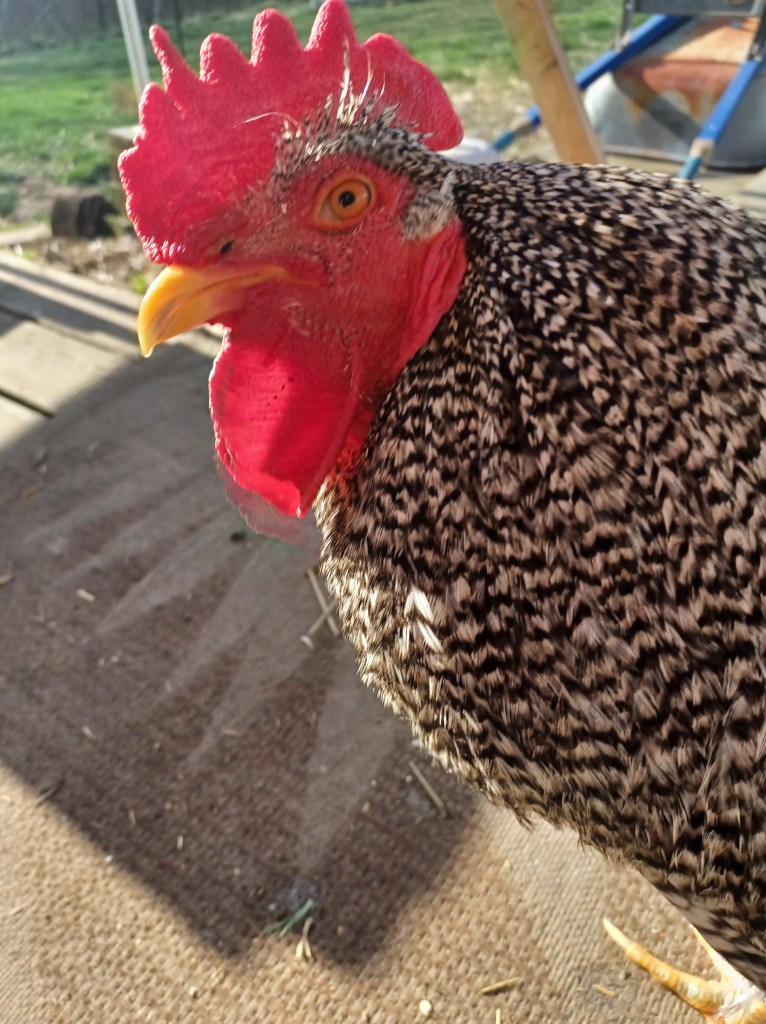
Is A Rooster Right For You?
Roosters can make a wonderful addition to your backyard flock. In addition to protecting your hens, a rooster can service your hens to provide you with fertilized eggs. Roosters have beautiful plumage and with extra time they can be trained to make excellent companion animals. Roosters are a male, intact livestock animal with strong instincts and urges that dictate their behavior. Roosters don’t act out of malice or meanness but instead they respond out of instinct to situations they consider threating to their flock. If a rooster isn’t given the circumstances he needs to succeed, this can result in injury to him, your hens, and you. Roosters are often mislabeled as aggressive or mean by individuals who didn’t properly research their care needs. Nature and nurture will both play a role in whether or not your rooster is a productive and happy member of your flock.
Breed characteristics will play a role in the demeanor of your rooster. Game breeds are considered among the more aggressive breeds as their more aggressive behaviors have been intentionally heightened by human breeding. These breeds would not be a good fit for a backyard setting. Rooster breeds that are known for their friendliness are breeds like: The Silkie, the Plymouth Rock, the Orpington, Faverolles, Sussex, Jersey Giants, Cochins, and the Polish rooster.
There are many important things to consider before adopting a rooster. Firstly, if you can legally own one in your area. While many areas are now receptive to backyard chickens several still have laws prohibiting owning a rooster. Roosters are loud. They do not just crow in the morning but will crow throughout the day for different reasons. In the act of mating with your hens it is possible for your rooster to do physical damage to them especially if there is a significant size difference or if your flock isn’t large enough to support a rooster’s normal level of activity. Roosters are aggressive by design as their two main objectives are: to protect their flock, and to service their hens. Roosters can interpret the chaotic movements and loud noises of small children and other animals as an attack on their flock and they will respond accordingly. Adopting a rooster is a commitment to his care and training needs especially if you keep your flock in such a way that you will interact with them in their area on a regular basis. You don’t need a rooster to enjoy fresh eggs from your backyard chickens. Your hens will lay without a rooster, your eggs just won’t be fertile.
I would not recommend roosters for the following situations:
If you can’t legally own them in your area.
If you have a small flock with less than six hens.
If you have a small, confined space or if you are already struggling with space issues for your flock.
If you have small children.
If you’re hesitant or uncertain for any reason about adopting a rooster. Wait and research first, adopt when you decide it is good for you and your flock. It is very easy to adopt a rooster. It is much harder to rehome one.
Your rooster’s natural behaviors and instincts include crowing, physical aggression, and mating with hens. These behaviors serve a role just as they did for their wild descendant counterparts. Now as domesticated livestock animals these instincts still exist and have been enhanced by humankind in many ways to serve our purposes. These instincts are part of your rooster and if they’re not channeled in a positive way the results can be disastrous.
It is a myth that roosters crow only at sunrise. Roosters crow throughout the day and for a variety of reasons including alerting the flock to predators and declaring their territory. In my flock I have noticed my roosters will crow at dawn, midday, and at dusk. If a rooster is crowing at night, it is usually an indicator of an issue. The more unhappy a rooster is, the more often he will crow. Some breeds and individual roosters will be more vigilant than others. Excessive crowing can be an indicator of stress, inadequate space, unaddressed predator pressure, or perpetual disturbances such as loud noises or lights that interrupt your chickens while they’re sleeping in their coop. Make sure your coop is located in a quiet, well insulated place. You can use things like walls or shrubbery to provide sound dampening if you’re keeping chickens in a developed area to add to the peacefulness of the coop. Ensure your coop is predator proof and regularly check your chicken infrastructure for signs of predator pressure.
A rooster needs at minimum six hens but preferably seven, and one rooster can reliably service up to ten hens meaning that the vast majority of the eggs produced from your flock will be fertile. Chicken mating if you haven’t seen it before can be alarming. When a rooster mounts a hen to service her, he can also in the act of mating pull feathers from her back and from behind her head. Some feather loss is normal in the act of servicing hens. Damage is excessive if your noticing wounds, blood, or injuries to your hens. This can be the result of an unbalanced flock (not enough hens for your rooster) or if the rooster is a bad match for your flock (if there is a significant size difference). Roosters will by nature be larger than hens but if the size difference is too extreme this can result in unintended injuries like leg injuries of excessive feather loss. Roosters will also have a ‘favorite’ hen, even in a balanced flock there will likely be one hen who gets a disproportionate amount of rooster attention. You can use items like a hen saddle if that’s appropriate for your situation. If you use a hen saddle, you will need to check your hen daily to ensure the saddle has not slipped and remove it regularly to clean it. There are varying schools of thought on hen saddles whether they are a useful tool or not, you will have to do your own research and make that determination for yourself. Some roosters due to poor genetics, experiences, or breeding simply won’t be a good match for your flock. If your hens even after several weeks of acclimation seem terrified and you’re noticing an excessive number of injuries it is possible for a variety of reasons that particular rooster just isn’t a good match for your flock.
Roosters have sharp protrusions on their legs called spurs. These spurs are meant to defend their flock from predators but they can accidentally harm your hens. Rooster spurs can be trimmed and kept dull similar to dog nails. Don’t trim a rooster spur too small because you will cut the quick which can result in bleeding and pain and in extreme cases even the death of the animal. Properly research trimming rooster spurs and obtain the appropriate equipment prior to attempting this. Not all rooster spurs will need to be trimmed, some are shorter and duller. Whether this is needed should be determined on a case by case basis.
Roosters will attack for a variety of reasons. Rival roosters and predators are the main reasons. As a chicken owner your normal movements can also be perceived as threats. Entering the chicken area which is their territory, handling and especially picking up hens, and moving through their space quickly are all things your rooster may perceive as danger. Other things that can trigger rooster aggression are physically towering over them, loud noises, and changes to their environment. The more stressed and unhappy a rooster is, the more aggressively they will behave. You can help condition your rooster to a wider range of experiences by handling them often from a very young age. You can also set your rooster up for success by creating space for his natural behaviors and meeting his basic needs.
There are suggested techniques to deter aggression in roosters but things like physically dominating or striking your rooster are not just ineffective and in fact, along with being cruel, more often than not will result in an increasingly aggressive rooster. You can’t train a rooster like any other animal and you can’t harm them into submission. You can however create circumstances conducive to their success and learn to respect their behaviors for a better experience for everyone involved.
Roosters will present physical signs that they are preparing to attack something. Their heckles, the feathers on their neck will raise, and they will focus intensely before charging and attempting to peck or flog, which is their defensive kick attack which includes the use of their spurs. If you can observe these signs, you will be able to spot when your rooster is beginning to act aggressively. Rooster behavior is also impacted by the seasons. In the spring time roosters will vie for flock dominance and the right to mate with hens. A normally docile rooster might act abnormally aggressive in the springtime due to the natural fluctuation of his hormones and in accordance with natural chicken mating behavior. Not all rooster pecking is intended to be aggressive. Like hens, roosters will also sometimes peck to explore an object.
There are things you can do to prevent aggressive encounters with your rooster while maintaining your chicken area. Firstly, if you keep your flock in containment and don’t interact with them as pets, you can simply maintain your chicken area after your flock has roosted for the night and is asleep. You can isolate your rooster in the coop while maintaining your chicken area and release him once you’ve finished your chores and no longer need to be in spaces he considers his territory. Always wear appropriate clothing when doing livestock chores which includes sturdy high boots and long pants that cover your legs. You can also carry a bucket or basket to place between you and the rooster when completing tasks to redirect his aggression toward an object instead of you.
You can decrease the chances of a negative encounter with your rooster by remaining calm and moving slowly when in your chicken areas. Refrain from picking up or handling hens in front of your rooster as this is similar to predator activity such as a hawk picking them up. Don’t tower over your rooster or forcefully move him, as relocating him resembles sparing behavior and is likely to trigger aggression. I have also noticed in our backyard flock my roosters seem most energetic and defensive in the morning. By simply moving my chore and maintenance routine to later in the day I have positively changed our interactions for the better.
You can set your rooster up for success by doing things such as:
Ensuring your rooster has adequate space. Overcrowding causes and exacerbates many negative health and behavioral conditions.
Ensuring your flock has adequate food and water.
Clean and maintain your chicken areas in a timely manner. Unsanitary conditions cause and exacerbate many negative health and behavioral conditions.
Reducing stress by providing predator proof housing.
Having adequate rooster to hen ratio (one rooster for six but up to ten hens).
Only having one rooster.
Keeping your roosters’ spurs trimmed (if it is needed).
Adopting a docile breed of rooster.
Adopting a cockerel and handling him often, raising him alongside your flock or, adopting an older rooster that is at least two years old as their aggression diminishes after this age but so does their fertility so there is the trade off there.
Not exposing your rooster to young children or pets unless he is used to their presence.
Roosters can eat the same layer feed as your flock however they don’t require the calcium amounts that are in layer feed. If you’re keeping just roosters like for example in a bachelor pad run and coop style set up, a maintenance style or all-flock feed would be a good fit for them. Roosters require grit just like hens do to properly digest their food.
It is possible to keep multiple roosters in a bachelor pad removed from hens. Since I haven’t enacted this, I will refer to you research this topic in depth but it is a possible arrangement you can make for your excess roosters. Other options include responsibly rehoming or culling unwanted roosters. I encourage you to attempt other mitigation options first. Please do not attempt to cull or process an animal without having conducted proper research about ethical and humane practices and obtain the proper equipment.
When I have visitors with young children, I simply keep my chickens inside their infrastructure. It is as simple as that. I don’t invite even the possibility of an accident between a friend’s child and one of my livestock animals. Even well trained and tamed roosters can behave unpredictably around unfamiliar people and animals so I eliminate that risk and keep them away from each other.
Hand taming a rooster takes a significant amount of time and dedication but it can be done. Individual breed temperaments and results will vary. Like training any animal, some roosters will be more responsive to training than others. My hand taming regimen for my flock is I adopted all of my roosters as cockerels and handled them daily their entire lives. I intentionally acclimated all of my roosters to being touched and handled as I knew they would be living closely with me and my family in a small backyard on our micro homestead. Since we would all be sharing space, I prioritized their demeanor over other qualities because that was the priority for my situation, my flock, and my family. Other people have been successful redirecting rooster aggression by training other behaviors like jumping through hoops or performing spins for treats. I prioritized their friendliness above any other quality and have developed my flock around that priority. My roosters are still fertile and have produced fertile eggs. My roosters are still very effective flock protectors.
I have multiple roosters, and I think I have been successful with this arrangement because my roosters have adequate mates, I provide safe and healthy conditions for my flock, and also my bantam and standard size flocks operate like two distinct flocks. I intentionally have not filled my space to capacity to allow for extra space to allow for members of the flock to avoid each other when needed. I’m actively hands on with my flock on a daily basis and have actively prioritized training them for friendliness and handleability. I have also intentionally built my flock with breeds that are known to be docile and friendly.
I hope this was a good starting point for your research regarding whether or not a rooster is right for your flock.
Check out Chuck’s other social media for more backyard chicken and homesteading content.
https://www.youtube.com/channel/UC6CjdDVs4qN1xxxJXAH6sOg?sub_confirmation=1
 Chuck and the Chicks