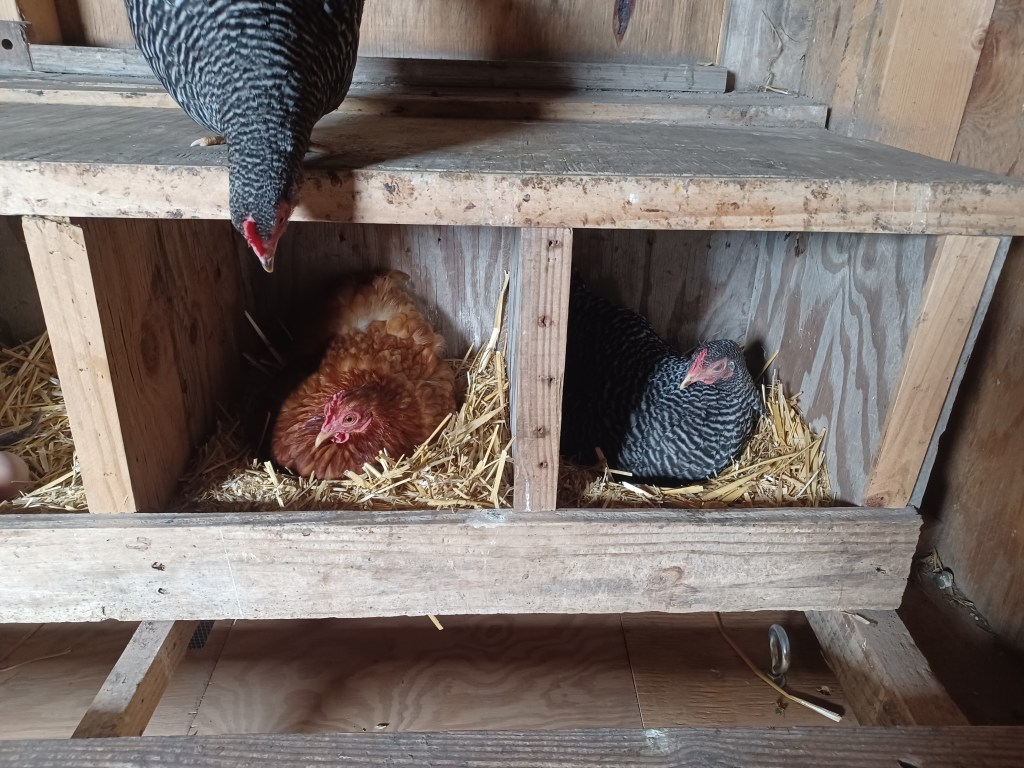
The cycle of an egg, how many eggs can a chicken lay?
As your hens physically mature, they will begin to lay eggs. Many factors impact how many eggs your hen will lay in her lifetime and with what frequency. One major factor is the breed of chicken you are keeping. Humankind has overtime selectively bred and developed certain breeds of chicken that are known as high production egg layers. Breeds such as Leghorns or Rhode Island Reds are capable of laying up to 250-300 eggs per year. Other backyard dual purpose breeds such as Buff Orpingtons, Australorps, and Barred Rocks are also good layers. An ornamental breed like the Silkie however can be expected to lay between 100-120 eggs per year, but high egg production is not one of the traits that was enhanced in this breed of chicken. If high egg production is a priority, certain breeds will be better suited to that role than others. Ornamental breeds, companionship breeds, show breeds, and meat birds all have desirable qualities that are different from high egg production.
Your hen will lay eggs without the presence of a rooster. While keeping a rooster has many positive aspects, they are not necessary for egg production. You will need a rooster if you want to produce and hatch your own fertile eggs or if you want a rooster for flock protection. *Please be certain you can legally own a rooster prior to adopting one. I do not recommend rooster for families with small children. With proper handling and training roosters can be hand tame and an amazing addition to your flock but this can take an enormous commitment of time, dedication, and consistency. You do not need a rooster to enjoy fresh eggs, you need a rooster if you want fertile eggs.
The creation of an egg starts in your hen’s ovary. When a matured ovum is ready to become an egg it travels through the infundibulum (this is where if you did own a rooster the egg could be fertilized), then it travels through the magnum where the first layers of the albumen are added (albumen is the white part of the egg), then the egg passes through the isthmus where the inner membrane, outer shell membrane and more albumen is added, then it arrives at the uterus or shell gland where the last of the albumen, the shell, and the shell pigment is added. Inside the vent at the hen’s cloaca the reproductive and excretory tracts meet. Hens lay eggs and excrete waste from their vent but not at the same time. As the hen makes her final push to release and lay her egg, the bottom end of the oviduct turns inside out, surrounding the egg and for that moment closing off the intestinal opening. Prior to an egg being laid it rotates inside the hen’s body 180 degrees so the rounded larger end emerges first. Hens often celebrate all of their hard work with an egg song, announcing to the flock they safely laid their egg.
The entire cycle of creating an egg can take between 24-26 hours. It is possible for a hen to lay twice in one day although it is extremely rare. 3 eggs from the same chicken one day is not physically possible. Double yolks can occur as a glitch as a young chicken is maturing or if they’re overfed. In our flock we typically see one of two double yolks occur in the spring as our girls are resuming egg laying after their winter dormancy.
Hens do not lay one egg a day as this cycle is impacted by their exposure to light. Egg laying production will be highest in the summer when the days are long and it is normal and natural for your hens to experience several egg free days in the depths of winter when the days are shorter and the temperatures cause their bodies stress just doing daily activities. *I do not recommend using artificial light to manipulate your hen’s laying cycle. Chickens were meant to take a natural break in the winter as their bodies cope with the seasonal change. Manipulating their egg laying cycle can reduce their lifespan by as much as half as well as cause additional harm and health complications. Other conditions that can cause your hens to stop laying include but are not limited to: inadequate or improper nutrition, molting, dehydration, stress, injuries, diseases, pests, old age, or harassment and disruption while laying. *There is no such thing as a lazy hen! Hens will not stop laying eggs as an act of emotional defiance. If you have a chicken that has ceased laying eggs it is an indicator or an environmental or physical condition. When their basic needs are met hens will healthy, thriving, happy egg producers.
Hens will reach the height of their egg production within the first two years of their life and then the production will gradually wane. Hens can lay eggs up to 7 years of age but as they age, they will lay considerably less. The rate of egg laying as they age will also be determined by factors including breed, lineage, health, and environment. Hen can be productive for many years past their prime but their egg production will gradually and naturally decrease.
I’ve often encountered the question have you ever cracked open a fertile egg and found a partially developed chick. No, I have not. It takes a hen consistently laying on an egg for 21 days for it to develop into a fully formed chick. As long as you are collecting your eggs daily, there is no danger of this happening. I would not recommend eating eggs from a hidden nest you discovered for several reasons. As long as you are collecting your eggs daily and in a responsible manner there is no risk of this happening as it takes 3 weeks for a chick to form.
A blood spot in an egg is caused by a ruptured blood vessel on the surface of the yolk as the egg is forming. This process is harmless to both the egg and the hen is a normal occurrence. Blood spots can be caused by a change in lighting, fluctuating stress levels, or during times of seasonal and temperature change. An egg with a blood spot is safe to eat.
Blood on the surface of the egg can indicate a young hen is beginning to lay. A small smear of blood when a hen first begins to lay her eggs is normal. Continuous, consistent signs of blood on your eggs can indicate things like a vent injury, prolapse, an aging hen, mites, or other health conditions. An isolated blood smear in a young flock is not cause for alarm, but continuous signs of blood should be investigated as a health issue.
I hope this information was interesting and helpful to you! Check out Chuck’s other social media for more backyard chicken and homesteading content.
https://www.youtube.com/channel/UC6CjdDVs4qN1xxxJXAH6sOg?sub_confirmation=1
 Chuck and the Chicks