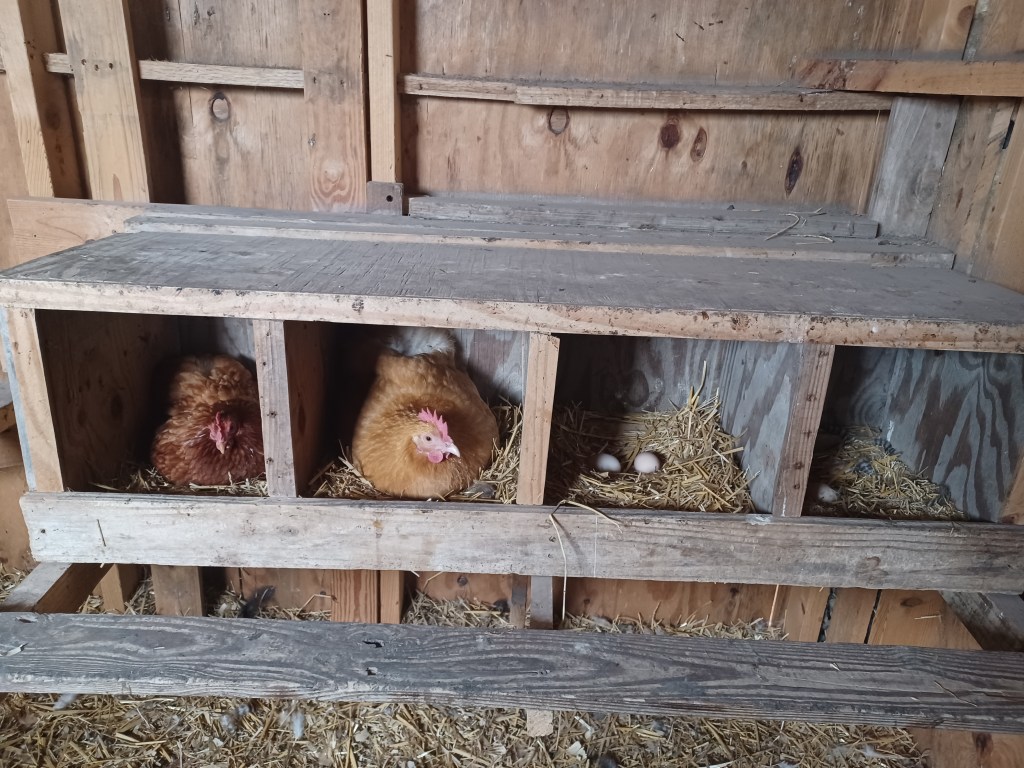
Nesting Box Basics
Nesting boxes provide a safe and stable environment for your hens to lay their eggs. While chickens will lay eggs regardless of whether they have access to a nesting box, maintaining clean and accessible nesting boxes is highly recommended for a variety of reasons. Nesting boxes make egg collection easier for you to complete on a daily basis so you don’t miss any of your hen’s hard work and it won’t go to waste. Well maintained boxes discourage chickens from eating their own eggs because they can be collected in a timely manner. Without adequate nesting boxes eggs won’t be just hard to find. Lost eggs can result in unplanned chicks as well as encourage predators to view your chicken area as a food source. Maintaining adequate and clean nesting boxes is considered part of responsible backyard chicken keeping.
Nesting boxes for standard size chickens are recommended to be at least 14 inches by 14 inches (14 inches height and 14 inches width). For smaller breeds, a 12 inch by 12 inch box should provide plenty of space. Larger, heavier breeds will require a larger nesting box. The ideal box is large enough for your hen to comfortably do a full rotation without struggling. A few inches of depth to the box allows the hen to sink comfortably into her nesting area to lay her egg. The box should be large enough for your hen to get in and out of but not so large she feels exposed while laying her egg.
It is recommended to have at least one nesting per 4 hens, and to have at least 2 boxes minimum even for a smaller flock to avoid a traffic jam, that is, multiple hens attempting to lay without adequate boxes. Hens will demonstrate an inexplicable preference for one box often even when presented with many options. If you’re noticing your hens are reluctant to try the new nesting boxes you have provided you can use a faux egg and place it in one of the nesting boxes. This shows the hens that the nesting box is a safe place to lay eggs and they are more likely to give it a try themselves.
There are a variety of nesting box lining materials available. The most common nesting box lining is materials like straw or soft wood chips like pine shavings (not mulch). There are also premade disposable nesting liners that are available. You can even use gathered leaves and grasses as long as they are totally dry and free from yard chemicals. Whatever lining material you choose, it should be cleaned regularly and in a timely manner as hens will not choose to lay in a heavily soiled box. An unmaintained nesting box can also become home to unwanted pests and infestations. I use a castile soap mixture during deep cleans to clean my nest boxes. Between deep cleans I refresh the nesting liner as needed. While some small amount of droppings does occur occasionally, if you are finding your eggs and boxes are regularly filled with droppings this could be an indicator of a health issue such as worms or an indicator your hens are using your boxes to roost in. Refresh your nest box lining as needed and investigate any possible health issues.
Where do you put your nesting boxes? While you can place nesting boxes on ground level for aging hens or hens with mobility issues, nesting boxes are typically at least 18 inches off the ground for our convenience as well as additional safety and privacy for your hens. Chickens will naturally gravitate towards the highest place to roost at night for safety so to be sure to provide roosts that are higher than your nesting boxes.
Your nesting boxes should be someplace safe, quiet, and preferably slightly dim. Don’t place your nesting boxes in a noisy, high traffic area or your hens are unlikely to use them.
What design is best? There are almost as many nesting box designs are there are chicken breeds. Ultimately you will have to make decision based on your situation which design is best for you. There a variety of options but factors that might influence your choice are: your budget, the size of your flock, the size of your chickens, the purpose of your chickens, and your chicken infrastructure. Chickens that are raised on pasture often have access to a mobile coop and nesting boxes. They do make roll away boxes that are designed to make egg collection easy and to make it impossible for a hen to go broody sitting on eggs. I have never used that design for multiple reasons but it does exist as an option if that is better for your particular situation. Whatever design you choose the ultimate test is whether or not your hens actually utilize them. Some nesting boxes can be made from things like milk crates, sanitized cat litter boxes, baskets, old drawers, buckets turned on their side, boxes of all shapes and sizes. You can choose to mix box designs or try different types if your hens don’t gravitate towards your first set of boxes. Every flock will slightly different. Experiment to find the design that works best for you or you can utilize multiple designs. On our micro homestead our nesting boxes are in our stationary coop. They are constructed from up-cycled scrap lumber. I use straw as our nest box lining material. I previously used soft wood chip shavings but my hens showed an obvious preference for straw so I switched.
If you’ve created the perfect boxes, they are well maintained and clean, accessible and peaceful, and your hens still aren’t using them here are a few possible reasons you might investigate:
*The nesting boxes are too small.
*The nesting box area is loud, noisy, or too active.
*There aren’t enough nesting boxes.
*The placement of the nesting boxes is inaccessible (too high, awkward angle, etc.)
*The liner is unpleasant or heavily soiled.
*There is a splinter, nail, or protruding object that makes the nesting box unusable.
*There is a predator hunting in the nesting box area.
Snakes and rodents are notorious for hiding in coops. If your hens seem to be intentionally avoiding their area pay attention and investigate to be sure you don’t have any unwanted predators in your chicken area.
I hope these basic tips about nesting boxes were helpful to you!
Check out Chuck’s other social media for more backyard chicken and homesteading content.
https://www.youtube.com/channel/UC6CjdDVs4qN1xxxJXAH6sOg?sub_confirmation=1
 Chuck and the Chicks