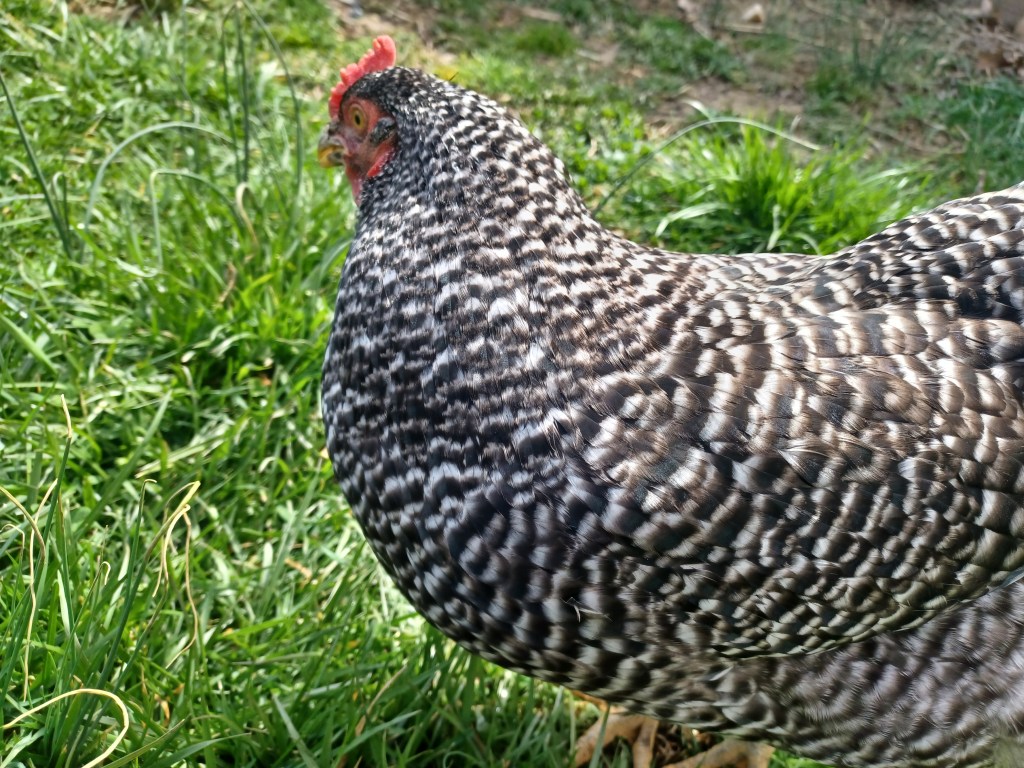
Pictured above, Laverne, a Dominique hen.
Mites and lice can be a highly inconvenient and costly issue to deal with amongst your backyard flock. Mites and lice impact your chicken’s overall health, productivity, and happiness. They cause uncomfortable and unsightly symptoms that left untreated can cause your chickens high levels of distress or even in some cases death.
Mites and lice are parasites that survive by feeding on other creatures like your backyard chickens. They have small, round bodies and six legs. You will recognize them by their straw colored or red bodies. They can appear very small, as small as the tip of a pin but you can see them.
Mites and lice congregate on your chickens in places you may not regularly check like the base of their feathers close to their skin or their vent area. This is one of many reasons regular and seasonal health checks are important so you can catch the first signs of these creatures and begin the appropriate treatment regimen.
Mites and lice can cause symptoms in your chickens like the following: patches of lost feathers, persistent diarrhea, bloody spots on their legs and feet, pale combs and waddles, swollen, raised, or displaced scales on their feet and legs, and weight loss.
Treating mites and lice can be labor intensive and costly. The better situation is to never encounter these parasites at all. Here are some tips that will help you prevent mites and lice from preying upon your flock.
Daily and seasonal cleaning and maintenance of your coop, run, and chicken areas. I can’t stress enough how paramount a timely and appropriate cleaning and maintenance schedule is to the health of your chickens. Regular cleaning preemptively deters many unwanted backyard flock pests and behaviors. Scrape droppings from roost poles, perches, and nest boxes daily. Maintain appropriate levels of clean litter for your chickens, refresh or spot clean according to your chosen litter method (deep bedding or spot cleaning and refreshing). Change out your litter in entirety on your appropriate seasonal schedule to keep mites and lice from making a home and replicating in soiled, decaying litter. In addition to refreshing your nest box bedding and coop and run litter regularly, I also do seasonal deep cleans with a natural castile soap mixture. *Never use harsh cleaning chemicals in your chicken area. * This can harm or kill your chickens. Instead, use a mild all-natural cleaner like castile soap. Dilute according to the directions on the bottle and apply with a reusable spray bottle. Clean roost poles, perches, and nest boxes with the soap mixture. Don’t apply moisture to your coop or run area if you are anticipating freezing temperatures. Wipe areas of heavily accumulated dust with an old rag towel and the soap mixture. This same all-natural castile soap spray can also be used as a perimeter spray to make your coop or run less inviting to pests. I spray the inside perimeter of my coop with the soap mixture during seasonal cleans. To make cleaning chores less labor-intensive store your tools in your coop if possible. If there isn’t room consider keeping your cleaning supplies close to your chicken area in a weather-proof tote or container to save you steps during necessary cleanings.
Observe a 30-day isolation period for new chickens. Whether they are new baby chicks or adult birds make sure when introducing new members to your flock to observe them in isolation for 30 days before introducing them to your existing flock. Many chicken diseases and pests are highly communicable and can spread quickly throughout your flock. This isolation period ensures new members are healthy and free from diseases and pests.
Your chickens need access to a dust bath all year round to be healthy. A dust bath is how chickens remove unwanted pests and dirt and other matter from their skin and feathers. Chickens have an amazing ability to keep themselves healthy if they are given adequate space and the tools to do so. A bath container does not need to be fancy. Our chicken bath is made from a repurposed planter but you can use other objects like spare tires or other styles of containers. Make sure your object is shallow enough for them to get in and out of easily and that there are no sharp edges. I use a combination of clean fill dirt and wood ash in our chicken bath. The wood ash comes from fallen wood on our property and contains no chemicals, so no treated wood. If you don’t have access to wood ash it can also be purchased by the bag. Combine the ash with clean fill dirt. I would not use just ash as it can be too airborne by itself and cause respiratory issues if inhaled. You can also add a small amount of diatomaceous earth *FOOD GRADE* to your chicken’s bath mixture. It needs to be the *FOOD GRADE* diatomaceous earth, not the pesticide diatomaceous earth. The food grade diatomaceous earth will have pictures of animals on the packaging. *FOOD GRADE* diatomaceous earth can also be applied by itself directly to roost poles and nest boxes. A little goes a long way! Use a small amount if used by itself so your chickens don’t accidentally inhale it causing respiratory issues because it is very powdery.
Use a litter cover in your coop and run. Bare ground in a high traffic chicken area can quickly become mud saturated with droppings. Using a litter cover makes it possible to clear away droppings and reduces the presence of excessive moisture in your chicken area. The combination of excessive, decaying droppings and moisture contribute to and cause many chicken health and behavioral issues. The kind of litter that is best for you will vary based on your climate, infrastructure, and availability. I use pine shavings in our run and a combination of pine shavings and straw in our coop. While straw is good nest box material and a good material to use inside a dry coop, it is not recommended for a run area where it is likely to retain too much moisture. In our run I use pine shavings. Other litters you can use are, coarse sand (not play sand, this can be inhaled and cause respiratory issues), or smooth pea gravel. I would not recommend mulch as a ground cover in your chicken area. I use the rule of thumb if I wouldn’t walk on it in bare feet, I wouldn’t use it in my chicken area. Mulch contains sharp pieces which can injure your chicken’s feet and cause other issues. Keep your chicken areas free from mud and excessive accumulations of droppings.
If you find you are experiencing a mites or lice infestation, there are many natural and chemical over the counter remedies to eradicate this pest which can be found online as well as in farm box stores. Contact your local livestock veterinarian if needed.
I hope this information was helpful to you! Check out Chuck’s Youtube and Instagram for more backyard chicken and homesteading content.
https://www.youtube.com/channel/UC6CjdDVs4qN1xxxJXAH6sOg?sub_confirmation=1
 Chuck and the Chicks